 World of Shrimp
Cherry shrimp breeding: males, females and berried shrimp
Published · Updated · 5 min read
Quick answer
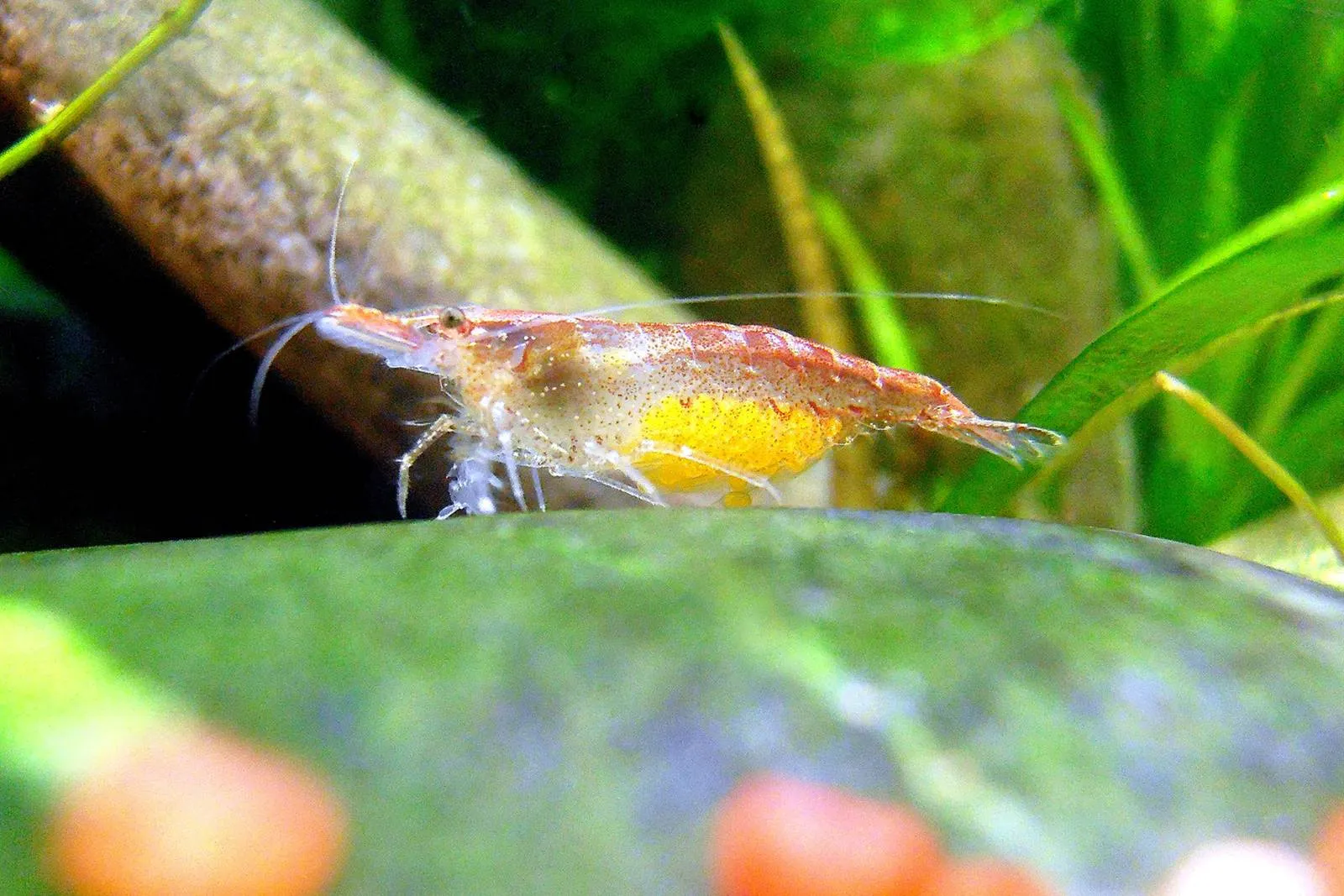
- Females are bigger and more colorful than males. Adult females often show a yellow or orange "saddle" of eggs behind the head.
- After a female molts, she mates and moves the eggs under her tail. She is then called "berried".
- She carries the eggs for about 3 to 4 weeks. The babies hatch as tiny copies of the adults.
- Stable water, enough food, places to hide and no fish are the main things a colony needs to grow.
Male or female?
Young shrimp all look alike. You can only tell males and females apart once they are a few months old.
| Feature | Female | Male |
|---|---|---|
| Size | Bigger, up to about 4 cm (1.5 in) | Smaller, about 2.5–3 cm (1–1.25 in) |
| Color | Brighter and stronger | Paler, often partly see-through |
| Saddle | Often a yellow, green or orange patch behind the head | None |
The saddle is a cluster of developing eggs inside the female's body, just behind her head. In deep red shrimp it can be hard to see.
How mating works
When a female with a saddle molts (sheds her old shell), she releases a scent called a pheromone. The males pick it up and swim fast laps around the tank looking for her. This sudden, frantic swimming is normal and stops after a while.
Soon after mating, the eggs move from the saddle to the underside of her tail. A newly molted shrimp is soft and likes to hide, so you may not see any of this happen.
Berried shrimp: carrying the eggs
A female carrying eggs is called berried, because the eggs look like a tiny bunch of berries under her tail. She fans them with her small swimming legs to keep them clean and supplied with oxygen.
| What | Typical number |
|---|---|
| Time carrying eggs | About 3 to 4 weeks |
| Eggs or babies per batch | About 20 to 30 |
| Size of a newborn | About 2 mm (1/16 inch) |
| Old enough to breed | Guides vary, from about 2 to 6 months |
Warmer water makes the eggs develop a little faster. Cooler water slows it down.
What to do when you spot a berried female? Nothing special. Don't catch or move her, keep feeding as usual, and avoid big or sudden water changes until the eggs hatch. A sudden change in temperature can make her molt early and drop the eggs.
Baby shrimp
Cherry shrimp babies look like tiny copies of their parents when they hatch. For the first few weeks they mostly stay in one area, hide and graze on biofilm, the thin layer of algae and microbes on every surface.
Because they are so small and hide so much, you may only notice the babies a week or two after they hatch. A tank that suddenly seems full of tiny shrimp on the moss and glass is a good sign.
To help them survive:
- No fish. Almost all fish will eat baby shrimp.
- A sponge filter, or a sponge over the intake of any other filter, so babies are not sucked in.
- Moss and fine plants to hide in.
- A mature tank with plenty of biofilm, plus a little powder food or leaf litter. Our feeding guide explains how to feed babies.
- A covered siphon during water changes, so babies stay in the tank.
How to help them breed
- Stable, clean water. Keep the numbers inside the usual ranges, with 0 ammonia and 0 nitrite. See our water parameters guide.
- Slightly warm water. Shrimp Science suggests around 23 °C, and Aquarium Co-Op says cherry shrimp are most comfortable at 22–24 °C (72–76 °F). Cooler water slows breeding.
- Enough food, including some protein. Well-fed shrimp feel safe enough to breed.
- Plenty of hiding places. Stressed shrimp breed less.
- A group of at least 10. This makes it very likely you have both males and females. More females than males helps, because each female can only carry one batch of eggs at a time.
- One color per tank. Red, blue, yellow and other cherry shrimp colors are all the same species and interbreed. Their babies usually turn back toward the wild color, see-through with brown spots. Our tank mates guide explains more.
Why females drop eggs
It is common for a female to lose some or all of her eggs, especially the first time she is berried. It usually happens less as she gets older.
Other causes are stress, poor water, too few hiding places, and a molt triggered by a sudden water change or temperature shift. Keep the water steady, especially while a female is carrying eggs. Our guide to shrimp molting explains why sudden changes matter.
FAQ
How do I know if my cherry shrimp is male or female?
Look at adult shrimp. Females are bigger and more colorful, and often show a yellow or orange saddle of eggs behind the head. Males are smaller, slimmer and paler. Young shrimp are hard to tell apart.
How long are cherry shrimp pregnant?
A berried female usually carries her eggs for about 3 to 4 weeks before they hatch. Warmer water shortens this a little, and cooler water makes it take longer.
Why did my berried shrimp drop her eggs?
It is common with young, first-time mothers. Stress, poor water, too few hiding places, or a molt triggered by a sudden water change can also cause it. Keep the water steady, and she will usually try again.
Do I need a separate tank for baby shrimp?
Not usually. In a shrimp-only tank with moss, plants and a sponge filter, babies can grow up with the adults. The main danger is fish, because almost all fish eat baby shrimp.
Sources
- Shrimp Science: How To Breed Dwarf Shrimp
- Shrimp Science: Neocaridina davidi
- Aquarium Co-Op: Care Guide for Cherry Shrimp
- Shrimp and Snail Breeder: Red Cherry Shrimp: Care, Diet and Breeding
- Shrimp and Snail Breeder: Shrimp Behavior: Why Do They Keep Swimming Around?
- Shrimp and Snail Breeder: How to Do and How Often to Do Water Change in Shrimp Aquarium
- The Shrimp Farm: Failed Molting in Shrimp
- The Shrimp Farm: Yellow Shrimp Tank Set-Up and Care
- Flip Aquatics: Cherry Shrimp Guide
- Wikipedia: Neocaridina davidi
Keep reading
-
 Shrimp molting: what a normal molt looks like and when it fails
What a normal molt looks like, the signs of a failed molt and how to prevent it.
-
 What and how often to feed shrimp
What shrimp eat, how much to give them and how to avoid overfeeding.
-
 Cherry shrimp tank mates: what can live with them?
Which snails, shrimp and small fish can share a tank with cherry shrimp, and which to avoid.